
The year 2024 saw the software product market valued at $1774.09 billion. Given the current rate of growth, the market is expected to reach $3040.45 billion by 2029 at a CAGR of 11.3%.
Tapping into this economically-feasible market is the right option, especially if you’re a founder with a market-disrupting product idea.
But there’s a wall that many enthusiastic founders bump into: turning the idea into an agile software product. The process is rife with challenges, challenges that can interfere with the success of a software product.
This guide on how to build a software product clarifies business owners about everything related to software product development.
You’ll gain clarity on the topics like the steps involved in the software product development lifecycle, the factors that influence the duration of development, and the common challenges faced during development. Dive right in!!
Key Takeaways 🚀🏆
- A market-ready software product can be developed from scratch in seven simple steps.
- Basic software products can be developed in 2 to 6 months. Complex ones can take over a year.
- Challenges like scope creep, security vulnerabilities, dependency issues, and version control are common when developing a software product.
- A software product development company can build a software product that’s agile and meets market expectations.
Looking for a Tech Partner to Build Software for your Enterprise?
Table of Contents
How to Build a Software Product: Development Steps
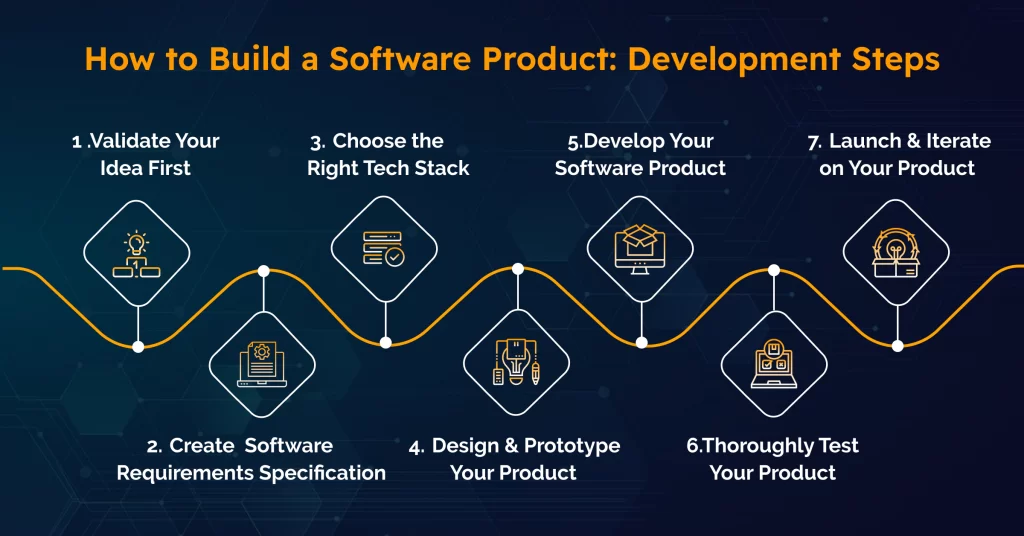
Creating a software product is a step-by-step process. Collaboration among teams, using the right tools, and adherence to industry standards ensure that the steps move smoothly with minimal hassles.
To build a software product, you have to validate your idea, develop an SRS, opt for a compatible tech stack, create a well-defined prototype, code and test the software product, and, finally, launch the product. Each of these steps is explained below.
✅ Step 1: Validate Your Idea First
Every software product development process kicks off with idea validation. The objective here is to prove that a product idea is feasible and is something that there is a market for.
Product discovery is the best way to validate a product idea. It includes strategies like market and user research and competitive analysis.
Upon successful completion of idea validation, you will have clarity on the marketability of your product idea and the next steps to take.
✅ Step 2: Create a Software Requirements Specification
A software requirements specification (SRS) is a detailed documentation of a software product that is to be developed. The document will be used by all the teams in the development process.
The document is similar to a blueprint, outlining the functionality of the final product and the steps it must follow to build the said functionality.
A well-defined SRS has two elements: functional and non-functional requirements. The functional requirements describe the overall functionality of the product, ensuring that the core features are accurately performed. The non-functional requirements, on the other hand, focus on system quality and performance.
✅ Step 3: Choose the Right Tech Stack
The tech stack is a critical aspect when building a software product. It decides the future upgrade path the developed software product will have to rely on.
The tech stack is also dependent on the platform and operating system you plan to launch the software product on.
It is important to note that the chosen tech stack also impacts the cost and development time. So, choose wisely!
Need Expert Guidance to Turn your Software Idea into a Real Product?
✅ Step 4: Design and Prototype Your Product
The UI and UX of the software product are vital to its success. An appealing UI and a smoother UX ensure hassle-free user interactions.
The design step of software product development usually involves the following.
- User Research: Analyze the market to strategize a design that is user-friendly and expresses your brand’s tone.
- Prepare Wireframes and Mockups: Create a hand-drawn sketch (wireframe) and well-defined representation of the final design (mockups) to share with stakeholders and development teams.
- Develop Prototypes: Prepare high-fidelity prototypes that map user journeys and test them for design flaws.
✅ Step 5: Develop Your Software Product
The product engineering team takes over, writing code to turn the idea into a functional product.
Most teams opt for one of the popular development methodologies, like Scrum or Kanban. These methodologies speed up the development process and promote efficient resource usage.
It is important to make sure development teams follow coding best practices (like writing clean code, using version control, and running frequent code reviews). These practices reduce the risk of major bugs and ensure the codebase is clean and easy to refactor.
✅ Step 6: Thoroughly Test Your Product
Testing is vital to software product development as it finds and eliminates bugs and performance issues, which interfere with the proper functioning of the product.
A well-defined testing strategy also focuses on the product’s security, building robust defense measures that offer protection from cyber threats and malware. Product teams often use automation tools, like Selenium, to improve the speed and efficiency of the testing process.
The most commonly used software testing strategies are unit testing, performance testing, integration testing, and regression testing.
✅ Step 7: Launch and Iterate on Your Product
A smooth launch is vital for a successful software product. A detailed launch plan is useful in this regard.
The launch plan includes strategies to detect and eliminate issues that may interfere with a successful launch. It also covers the promotional part of the software product.
After launching the software product, the improvement part begins. The team collects user feedback and performance metrics to find ways to enhance the product. This is a process that continues throughout the lifetime of the product.
How Long Does it Take to Build a Software Product?
Each step in the software development life cycle has to be completed before moving on to the next. The time required to complete each step can vary based on the complexity of the software project.
To give a rough estimate, the time taken to develop a software product can range from 2 months to over a year. The complexity of the project is a major factor when estimating the time taken to develop a software product.
Basic software products can be built in roughly 2 to 6 months. Software products with intermediate complexity take at least 7 months and, in some cases, up to a year.
The more complex software products, with advanced integrations, can take over a year for development.
The complexity aside, here is a stage-wise split of the time taken to build a software product.
| Development Stage | Approximate Time Taken |
|---|---|
| Planning | 1 -3 Weeks |
| Analysis | 2 – 4 Weeks |
| Design | 1 – 5 Weeks |
| Development | 4 – 12 Weeks |
| Testing & Debugging | 3 – 6 Weeks |
| Implementation | 1 – 3 Weeks |
| Maintenance & Support | Continuous Process |
Wondering How to Scale your Software Product with the Right
Tech Stack?
Additional factors play a role in the total time taken to develop a software product. They are:
- The size of the development team
- The scope of the project
- The project management approach
- The technology stack
- The availability of resources
Top Challenges When Developing a Software Product
Challenges are a common occurrence in most software development projects. Even the most carefully planned projects often run into delays when minor issues are overlooked.
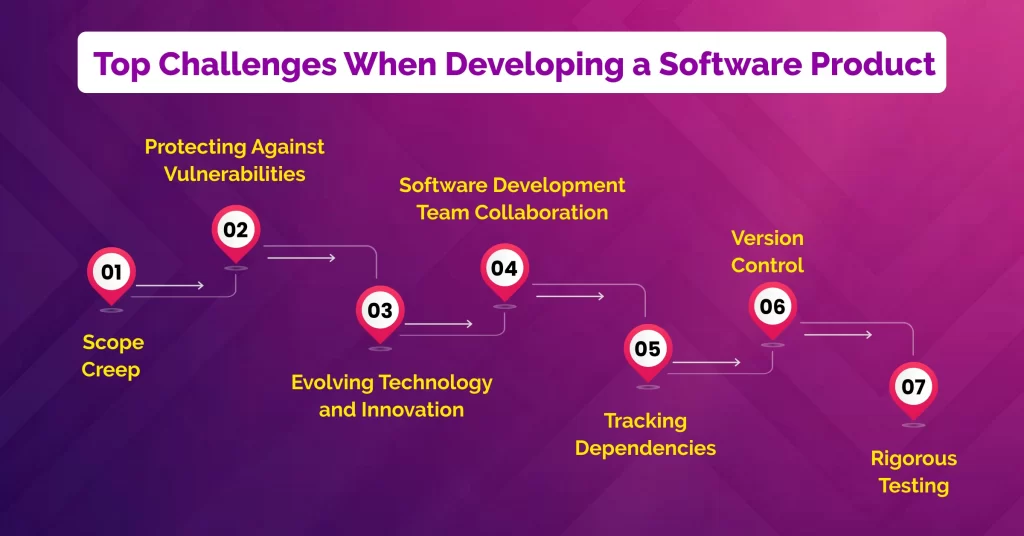
The top challenges development teams face when building a software product include scope creep, dealing with security vulnerabilities, staying updated with evolving tech, cross-team collaboration issues, keeping track of dependencies, version control issues, and testing challenges.
🚨 Scope Creep
Development teams, especially inexperienced ones, often get carried away when adding new features. Sometimes, this enthusiasm to improve the software product may lead to scope creep, leading to development delays. These delays inevitably lead to a shift in timelines for other processes.
Scope creep can be tackled by defining clear objectives in the planning and analysis stage. Development teams must also adhere to the identified objectives, rather than making improvements that impact the development timeline.
🚨 Protecting Against Vulnerabilities
New and innovative security threats seem to be increasing by the day. It is important for development teams to implement measures to create a robust product without vulnerabilities.
However, this is easier said than done. Development teams may have to shift from traditional methods to low-code/no-code solutions that are effective at preventing cyber attacks. But these solutions are fairly new, and the training required is often considered a deterrent for development teams.