
The demand to build AI software keeps growing every day because businesses have realized that AI software cuts costs, automates repetitive manual tasks, and speeds up decision-making.
A Gartner stat says that 55% of companies have taken up an AI-first strategy, showing the pressing need for businesses to create AI software. It’s easy to get overwhelmed by all the AI trends you see online, but all you need is the right roadmap on how to build AI software.
It doesn’t matter whether you are looking into creating your own AI tool from scratch or if you want to partner with an AI software development company; this blog will guide you through the practical steps of how to develop AI software in 2026. Let’s get started.
Key Takeaways
If you are a business owner looking to partner with an AI tech company, pick a company that offers strategy, compliance, and post-launch support.
Grand View Research has found that the AI market will reach USD $155.21 billion by 2030, with a CAGR increase of 37.6% from 2025 to 2030.
If you are looking into how to develop AI software on your own, start with a high-impact use case. Build an MVP to gain stakeholder trust and validate real-world impact.
Transform Business Operations With Custom AI-Driven Software Solutions
Table of Contents
Types of Industry-Specific AI Software
Before we get into the steps to build AI software, let’s take a brief look at AI-based software development in different industries.
| Industry-specific AI | Example |
| Healthcare AI | Helps with early diagnosis by analyzing medical images. They can also predict outcomes of treatments and help with personalized treatment plans. |
| eCommerce AI | Recommends products based on an individual’s shopping or browsing history. Analyzes trends and inventory and helps maintain stock at the right levels. |
| Education AI | Helps with attendance tracking and personalizes curriculum and lesson plans based on the student’s needs. |
| Finance AI | Predicts financial risk by analyzing economic indicators and helps with automated loan approvals and fraud detection. |
| Automotive AI | AI is used in automotive vehicles like self-driving cars. Monitors traffic and helps reduce fuel emissions and congestion. Also monitors vehicle parts for possible breakdowns. |
| Manufacturing AI | Has predictive maintenance capability, which keeps the machine from breakdowns and expensive repairs. |
| Human Resources AI | Automates resume screening and interview scheduling. Minimizes bias related to gender, race, and background. |
How to Develop AI Software Step by Step [7 Key Flow]
To develop AI software, you need to follow a structured process. The steps to build AI software begin with the clarity of defining the problem statement, which follows collecting the necessary data and processing it for training.
Once data prep is done, you can go ahead and select AI technology and algorithms to build the AI model. Finally, test the AI software, deploy it, and keep monitoring its performance to refine it.
Let’s take a deeper look at how each step works. Here is how to create AI software in 7 key steps.
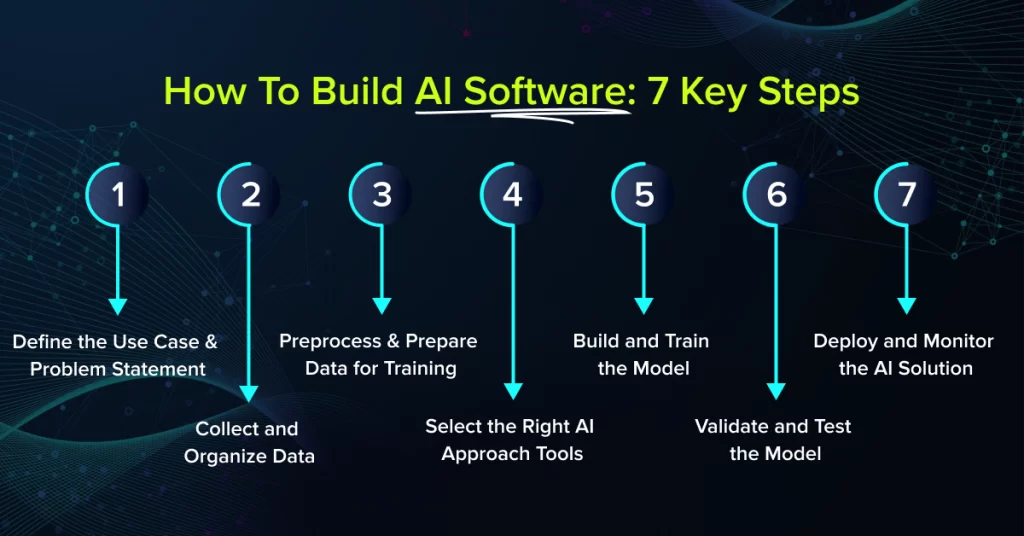
1️⃣ Define the Use Case and Problem Statement
How to create artificial intelligence software when you don’t know where to start? Well, start by identifying the problem and how your AI software will solve it. This is where you need to bring clarity on how it will provide value.
To set clear objectives, ask yourself
- Who will use this AI, and will it simplify their workflow? When you focus on the user benefit, it leads to practical business value.
- Does your AI software idea align with your bigger business goals? Tie it directly to customer experience and measurable goals to keep the AI project relevant and result-oriented.
Without this clarity in place, even the most experienced teams can struggle with how to make a AI software that delivers worthwhile outcomes.
2️⃣ Collect and Organise Data
If you want to know how to make AI software that solves business problems, you need to collect relevant data. It helps maintain a high-quality dataset. This can be a public dataset or proprietary data like transaction records, sensor data, customer interactions, etc. This keeps the model accuracy reliable for different scenarios.
Businesses often combine structured data (such as spreadsheets or databases) with unstructured data (such as images, audio, or text) to build richer applications.
Properly collected data lets you clearly see how to create an AI software that actually works in real-world scenarios.
3️⃣ Preprocess and Prepare Data for Training
Now that you have collected data, the next step is to process it for training. This is where you classify and label your data for AI to understand what it means. Remove any incomplete or duplicate data.
How to make an AI software that learns accurately from pristine data – 3 steps to remember.
- Name the files with clear names. It should be descriptive such that the LLMs get to know what is contained in the file.
- Turn your tables into plain text formats, such as XML, in order to make it chatbot-friendly.
- Retrain your AI model whenever you are adding new data or changing the data that is already available.
The preparation of data has a direct effect on the model performance. For example, when it comes to computer vision, images might require resizing and enhancement. And with natural language processing, there is tokenization and cleaning of text involved. Proper preprocessing is a core foundation to create AI software that learns from clean, structured, and bias-free data.
Build AI-Driven Software That Scales Your Business
4️⃣ Select the Right AI Approach and Tools
Choosing the right technique is highly important to developing AI software in 2026, with all these emerging technologies. Depending on the use case, developers pick AI technology and algorithms like machine learning, deep learning, natural language processing, or computer vision.
Equally important is selecting the right frameworks and libraries that support AI development, such as TensorFlow, PyTorch, or Scikit-learn.
Cloud-based AI platforms also provide pre-built services that speed up development by 2x. Infrastructure is another important consideration during this step, and it is the technical backbone of how to create artificial intelligence software.
This is the stage where all frameworks, algorithms, and infrastructure decisions have a direct effect on performance and scalability. The choice is on enterprises; the company needs to decide between open-source tools and commercial platforms.
For those exploring how to create your own AI software, start with open-source frameworks. Cloud-based resources make experimentation and scaling much easier.
5️⃣ Build and Train the Model
The next stage is model development, where developers build the AI model’s architecture. Whatever algorithm and framework were chosen in the last step are used here to create the model.
Then the AI model is trained using the prepared data. The model uses this data to learn how to complete the tasks that it is intended to do. Training is an iterative process, as the model learns from patterns and updates according to feedback.
An example is a recommendation system where the model learns user behavior to recommend relevant products. This stage requires computing power along with expertise. Why? Because poor training can lead to overfitting or underperformance.
However, a good training pipeline guarantees a 10/10 consistency, and, eventually, it determines how to create an AI software that learns, adapts and works precisely.
With all that said, how does one make their own AI when they have no coding knowledge? Well, you can opt for no-code AI platforms like Google Cloud AutoML or Microsoft Azure AI Studio.
6️⃣ Validate and Test the Model
Once the development part is done, the next step is the testing phase. Testing identifies how the AI software works in a real-life scenario. Developers typically split datasets into training, validation, and test sets to measure accuracy and robustness.
A separate validation set is used in testing the model to determine its performance and adjust its performance to fit real-world conditions. When we talk about model accuracy, it is essential to evaluate bias and fairness.
For example, an AI system built for healthcare should be tested across diverse patient groups. Continuous validation ensures the model adapts accurately over time. This is the essence of how to make an AI software that keeps improving with every dataset.
7️⃣ Deploy and Monitor the AI Solution
The final stage in how to build AI software is deployment. Trained and validated AI models are integrated into applications, workflows, or products where end-users interact with them. This may involve deploying on cloud platforms, edge devices, or on-premise systems, depending on the use case.
After the deployment, it is necessary to use monitoring in order to monitor the performance, track data drift, and ensure compliance. New data emerges every single day, and AI systems should be retrained on a periodic basis. Moreover, robust monitoring practices are a cornerstone to develop AI software that remains accurate, efficient, and relevant over time.
When you follow these steps to build AI software, you move with clarity right from idea to implementation with a structured process. This keeps your AI solution scalable and fully equipped to handle real-world scenarios.
Which Programming Language Is Helpful for AI Software Development?
When organizations try to find the answer for how to create AI software, one of the most critical choices they face is selecting the right programming language. This decision influences not just technical performance, but also development costs, scalability, and the time it takes to bring solutions to market.
Here, let us look at the top five languages that businesses commonly rely on when figuring out how to make AI software and the benefits they bring. Let’s take a look.